

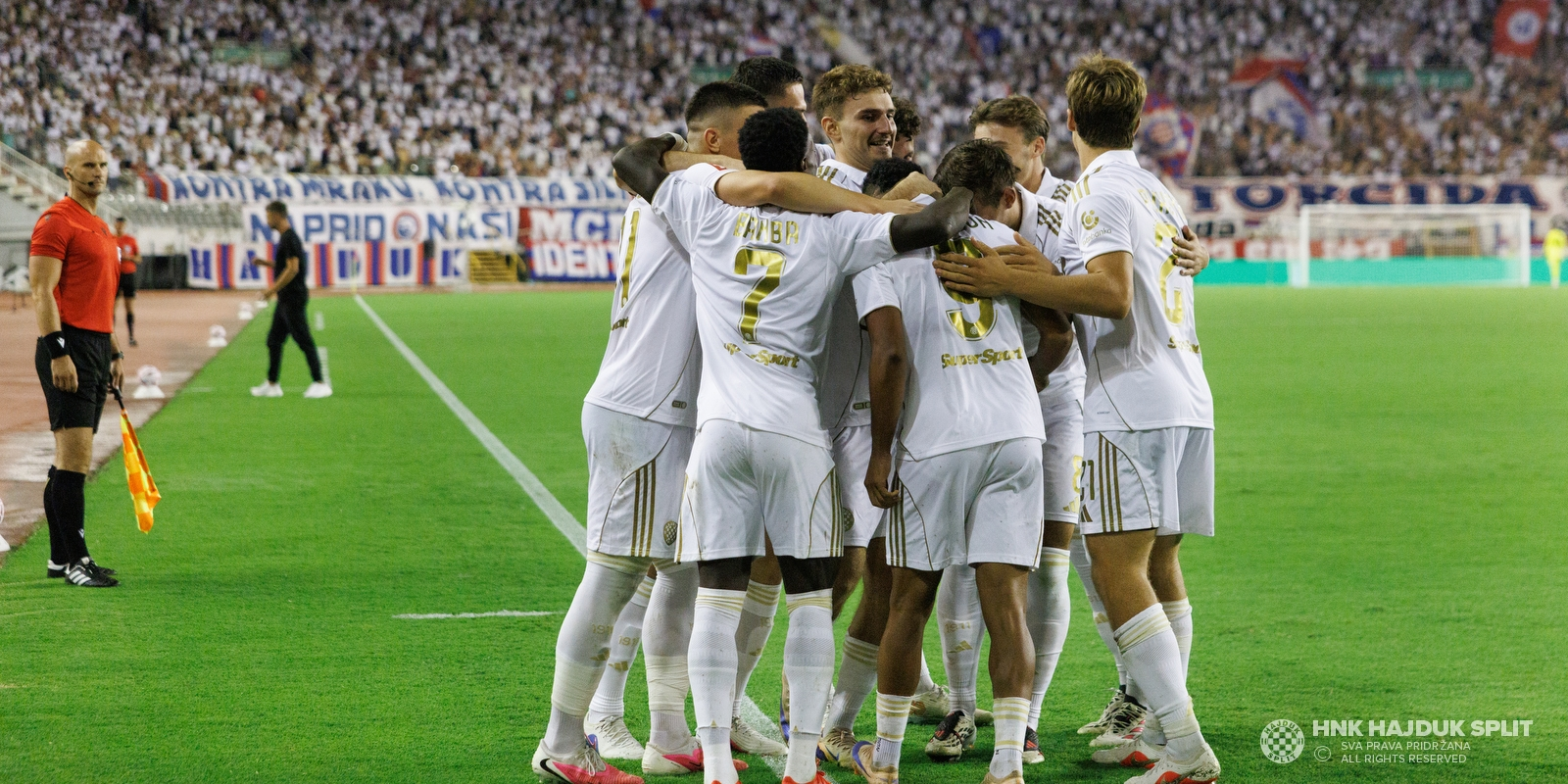
Sixteen years. That’s how long Split has waited for a proper European night, the kind where the group stage is on the line rather than just another summer qualifier that ends in a whimper before ‘Velika Gospa’. Hajduk Split is currently preparing for the 2nd leg vs. Rakow Czestochowa in the UEFA Conference League Play-off, which could see Hajduk enter the proper phase of a European competition for the first time since 2010.
The first leg ended 2-2 at Poljud, where Hajduk played a great game but wasn’t able to win, followed by a mesmerizing atmosphere that hadn’t been seen at Poljud for at least a year.
European Failures…
Before, Hajduk were always a big club in terms of European merit; they’re the only Croatian team to make it to the knockouts of the Champions League, back in 1995 when they got knocked out by eventual champions Ajax Amsterdam in the quarter-finals. But that high never came close to happening again. ‘Bili’ have only made the proper stage of a UEFA competition five times. Four of which were in the UEFA Cup before it was rebranded as the Europa League and moved to the group-stage system we all remember. Even in those UEFA Cup appearances, when it was a pure knockout tournament, the Split club got past the first round proper just once, in 2003/2004, when they beat Haka but fell to Roma.
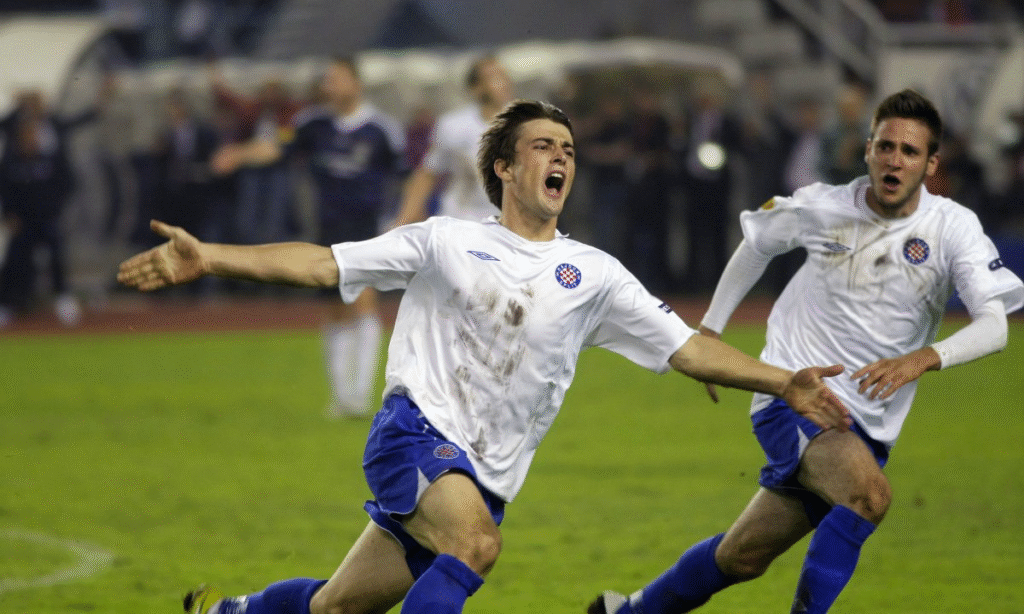
After that, Hajduk have only reached the group stage once since its introduction to the Europa League. So much time has passed that we now have league stages and three UEFA competitions. That one sole exception was the 2010/2011 season, when Hajduk beat Unirea Urziceni in the Europa League play-off to get put in a group with AEK Athens, Anderlecht and Zenit Saint Petersburg. Hajduk finished bottom of the group with just one win out of the six matches: the famous Ante Vukušić last-minute winner vs. Anderlecht at Poljud.
Ever since then, Hajduk have been unable to step up and enter the European scene again. A few times, they got close. Like in 2015 and 2016, when they faced Slovan Liberec and Maccabi Tel Aviv, respectively. Against Slovan, they lost 2-0 on aggregate and against the Israeli side, they lost on penalties at Poljud. Hajduk’s inability to win in Europe cost them their coefficient points, which meant they would always be on the unseeded side. This has cost them opportunities, as they’ve had to face the likes of Inter Milan in 2012, Everton in 2017, Galatasaray in 2020, Villarreal in 2022 and PAOK in 2023. In all of those instances, I would argue that Hajduk had a capable and mature team to play in Europe.
But luck of the draw wasn’t on their side. But when Hajduk gets beatable opponents in the play-off, closer to their level, it’s when the team is very mixed and has a bunch of young talent that is still developing (Slovan and Maccabi). And obviously we can’t talk about Europe and Hajduk without mentioning the early eliminations to Gzira United, Tobol, Ružomberok and Dinamo City in recent history. All of those shock losses bring us to this season…
Road to Rakow
Hajduk started this European season in the Europa League 1st qualifying round after finishing second in the league behind Dinamo, who secured the double. There they faced a familiar foe in MŠK Žilina who they beat 3-2 on aggregate, but it was very close to another heartbreak at the end as Slovaks put Hajduk under pressure. But Gonzalo Garcia’s team pulled through and drew Pafos in the following round. After a fantastic 2-0 win at Poljud in the first leg, Hajduk fell to a 4-0 defeat away in Cyprus after extra time. The Split club was just seconds away from beating last season’s Champions League side, but it wasn’t meant to be.
After dropping down to the Conference League 3rd qualifying round, Hajduk eased past Žalgiris Vilnius, a 9-2 victory over the two legs. And now, Rakow.
First Leg at Poljud: Hajduk Can Win
Hajduk hosted the Polish side at Poljud, which wasn’t sold out and had just under 26 thousand fans in attendance, despite the stadium rocking all 90 minutes, which it hadn’t done in a long time. Especially with how this season began with the Livaja-Garcia drama and divide among the fan base. But for this match, everybody got together, not to support Livaja or Garcia, but the club itself. Which is what it should normally be like.
Anyways, to the match: Hajduk set up as usual; this time, Garcia opted for two natural wingers in Šotiček and Bamba to abuse the space left on the far sides of the pitch as Rakow set up in a 3-4-3. It worked almost immediately: Bamba got the ball on the right wing and his cross found Šego, who headed Hajduk in front in the 21st minute. Sadly, Rakow answered just six minutes later, ex-Dinamo striker Mahir Emreli nodding home from an Otieno cross to make it 1-1. Rakow had a huge opportunity to make it 1-2 right before the half-time whistle as Silić made a save, but it came to Ameyaw, who hit the post.
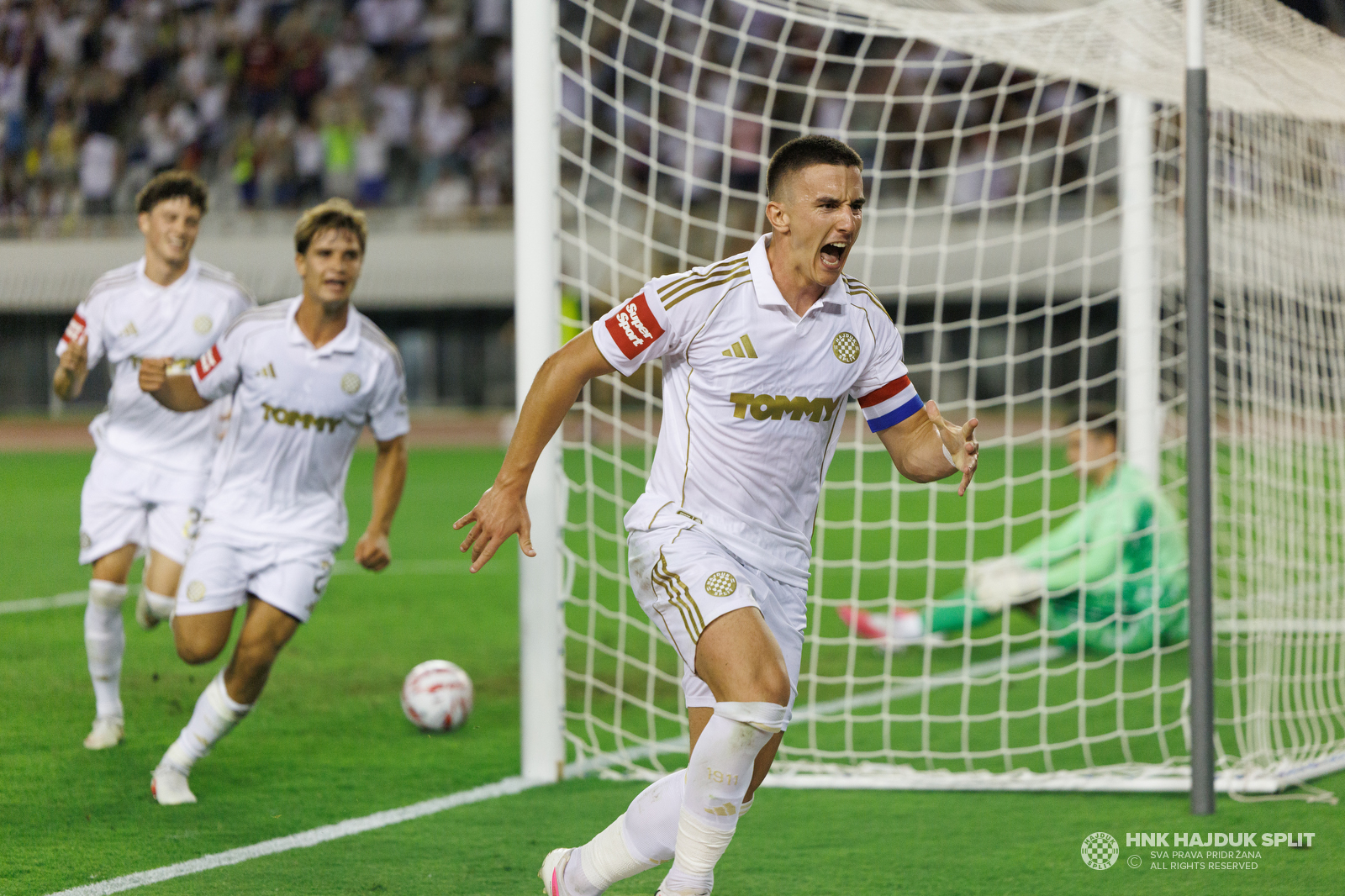
The second half started exactly how Hajduk wanted it to. Šotiček released Dalisson on the edge of the box in the 47th minute, and the Spaniard buried it from 18 meters to restore the lead. And just moments later, Bamba had a glorious chance as Rakow’s goalkeeper gifted him the ball with a misplaced pass. Bamba tried lobbing it to make it 3-1 and completely turn the game into Hajduk’s favour; sadly, his lob went wide.
Dalisson even had an amazing chance moments later that he couldn’t finish. Then, in the 55th minute, the game turned. Pajaziti went into a needless, heavy challenge just past the halfway line, and referee Michal Očenaš showed him a straight red without hesitation. From there, Hajduk spent the next 40 minutes performing well and actually threatening with ten men, but Rakow gradually took over the ball as the game’s end grew closer. Hajduk’s defence held, barely, until the fifth minute of stoppage time, when substitute Lamine Diaby-Fadiga, who’d already rattled the crossbar minutes earlier, finally beat Silić to make it 2-2 and send the tie to Częstochowa level.
What made the collapse sting even more was how well Hajduk actually coped with ten men against a side that last season barely lost to Fiorentina in the Round of 16 of the Conference League. But Hajduk were the better team out of the tunnel for the 2nd half, and hadn’t the red card happened, it’s tough to see how Hajduk wouldn’t have found another goal, as they were inching closer and closer after the Dalisson goal. But enough about what-ifs. Hajduk played a great game with a few defensive lapses in concentration, which have been a staple of Hajduk’s season so far and in recent history.
Overall, Hajduk played almost two-thirds of the match with eleven men and controlled it. Šego’s movement caused Rakow’s back three problems all night, Dalisson looked sharp and could’ve scored a second, and Bamba and Šotiček repeatedly found the space out wide that Garcia set them up to exploit. If Hajduk can get anywhere near 70 minutes at full strength in Poland — instead of the roughly 55 they got at Poljud — this team is capable of winning and sending Hajduk into the league stage of a European competition after a 16-year wait.
What’s Actually at Stake
For those less familiar with how European football’s financial ladder works, it’s worth spelling out just how much changes the moment Hajduk beats that first-round-proper barrier.
Based on last season’s confirmed UEFA figures (2026/27 numbers haven’t been published yet, but they’ll land close to this), simply reaching the Conference League league phase is worth roughly €3.17 million as a straight base fee, before a ball is kicked. On top of that, every win in the eight-match league phase is worth around €400,000, with each draw worth about €133,000.
Finish in the top eight and avoid the knockout play-off round entirely, and there’s a further €400,000 bonus; finish 9th-16th, and it’s €200,000. There’s also a ranking bonus pool, so the better Hajduk finish, the more they earn purely for where they land in the table — last season’s top side banked over €800,000 from that alone. Realistically, even a modest league-phase campaign: a few wins, a couple of draws, a mid-table finish — could be worth somewhere in the region of €4-5 million to Hajduk. That’s before any run in the knockout rounds, where the money jumps again at every stage, which Hajduk would reach with a mid-table-like performance.
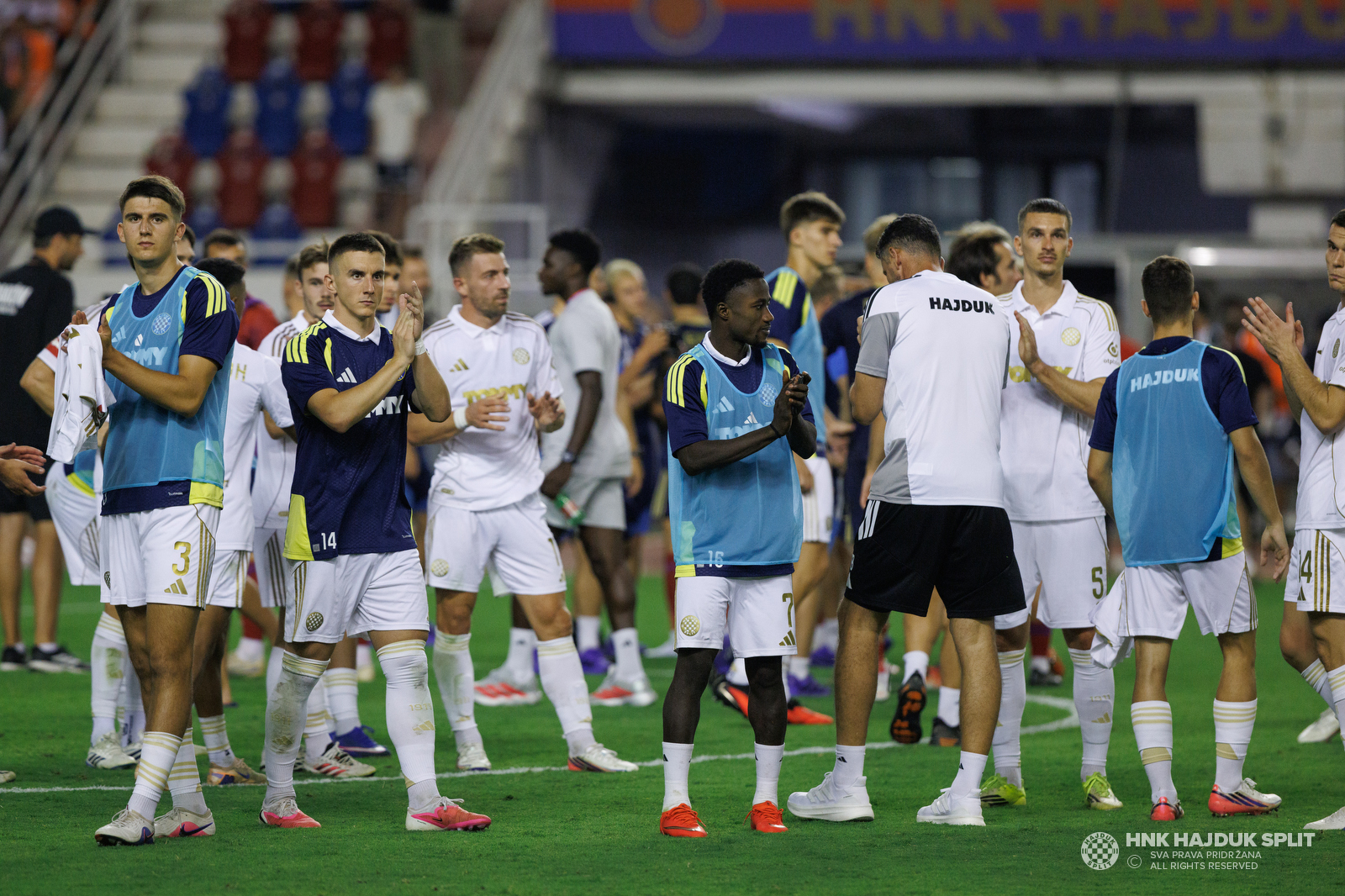
For a club that’s operated for over a decade without this desperately needed income stream, it would go a long way toward stabilising the club’s finances for the season. Especially with how sporting director Robert Graf has cut down on wages this summer. And not to mention how much it would mean to Split as a whole and the Hajduk fans around the country and the world for Hajduk to be on the European stage once again. That’s at least three more packed-out Poljuds, no matter the opponent. And if you get lucky in the draws, a path to the Round of 16 and Quarter-finals isn’t unrealistic. But we’re getting too ahead of ourselves.
Then there’s the coefficient. Every win, every draw, every round survived adds points that follow Hajduk into future seasons and directly shape who they draw next time around. This is the exact problem that’s haunted the club for YEARS — no points mean no seeding, and as a result, brutal draws against sides like Inter, Everton, Villarreal, and PAOK that a stronger coefficient would have avoided. Getting through this tie doesn’t just mean six extra matches this season. It means starting to climb back toward being seeded again, which changes the entire shape of Hajduk’s and Croatia’s European ceiling for years to come.
Thursday Awaits
Sixteen years is a long time to wait for a European autumn. Hajduk have had chances to end that wait before and found ways to fall short; some through bad luck in the draw and some through their own inexperience. Thursday in Częstochowa is another one of those chances, and on the balance of what we saw at Poljud, it’s the best one yet. And Hajduk enter it on a high note after demolishing Osijek 4-0 at Poljud with a heavily rotated side.
This Hajduk side doesn’t need a miracle, as they played the better football in the first leg for large stretches even with ten men, and only lost the result in the very last kick of the match. Garcia will have to figure out the game without Pajaziti, who, despite his questionable challenges and aggressiveness, has been crucial for Garcia, and Rakow will have home advantage at a small stadium that only holds 5,500 people.
Whatever happens, this tie has already given Hajduk fans something they haven’t had in a long time: a European night worth genuinely believing in. Split and Dalmatia crave proper European nights and away days. Thursday will decide whether they get it.

@RisingStarXI
·
🇭🇷🤯 𝗟𝗨𝗞𝗔 𝗩𝗨𝗦𝗞𝗢𝗩𝗜𝗖 (𝟭𝟵)’s Brighton career so far:
✅ CLEAN SHEET vs. Roma
✅ CLEAN SHEET vs. Bologna
✅ CLEAN SHEET vs. Tromsø
✅ CLEAN SHEET vs. Aston Villa
✅ CLEAN SHEET vs. Tromsø
100% Clean Sheets.
𝗜𝗡𝗦𝗧𝗔𝗡𝗧 𝗜𝗠𝗣𝗔𝗖𝗧 🔥
I saw a clip on Twitter showing Garcia at his post game interview and then several of his players crashing the interview singing and jumping, surrounding him and with complete joy and that makes me happy to see. I love this sport more than anything and I appreciate when players respect and play for their coach…its a good sign and healthy for everyone supporting them.
I saw that too. Was wondering if guys like Bamba learned the words to the song.
I think Bamba is a Ličan!
🤣
Bravo Hajduk.
Well deserved victory.
Rakow was playing physical and were flopping for large parts of the game, and the ref rewarded them with free kicks, stoppages at key moments, and a PK for their flopping efforts…but it was still not enough to beat Hajduk.
Hajduk dominated extra time, deservedly scored the winner, and Rakow were lucky not to concede more.
Rakow actually finished 2nd place last year in Conference League in group standings and narrowly lost in the knockouts to Fiorentina.
This is a big step up for Hajduk, who were losing to nobodies these past two years. Will be great for their coefficient ranking and we can build on this.
Self-hating Croats are on suicide watch.
Hajduk wins against all odds, and their beloved Zvezda (who had a 4-1 aggregate lead on Viktoria Plzen) just lost 1-5 and are out of Europa.
Red Star are now with Hajduk.
No Red Star are in Conf. League and could play Hajduk.
Finaly after 16 years we have done it 3-2 after extra time.
It was nerve recking watching the last few minutes and thinking are we going to hold out.
Overall, I think Hajduk deserved it.
How is the ticker after that one, MART? They didn’t give you any room to relax. . . .
I’ll echo Maminjo: bravo Hajduk!
I did not think that we were going to make it when it went to extra time, same as against Pafos.
Did not play well in the second half and were hanging on despite scoring a good goal on the counter to lead 2 – 1. As we say “gol je visio u zraku” and they scored in the 88th minute.
Being a diabetic, I checked my glucose level and it was way too high because of stress. Thankfully it returned to normal level 60 minutes after the end of the match. But yes, very stressful for a 68 year old.
I said this the other day and I meant it:
“as I said earlier, Hajduk was the better team in the first leg but had a mental lapse. they are playing above average and had a huge confidence boost this past weekend while Rakow has had some tough results recently.
this is a winnable game!”
hopefully this is the first step for Hajduk as a team to have self-belief, to have trust in their coach and for the attention to stay on the team and off the distractions (Torcida). teams begin to build on games like this. scoring 3 different times to take the lead and maintain a positive attitude is a big accomplishment and I’m happy for them!
They need to keep Garcia at all costs, and work on building their club coefficient ranking (so they’re never in a position where they have to win three rounds as an unseeded team just to get into Conference League).
I watched the game from beginning to end, and it would have been a travesty if Rakow won this one (especially with the lazy haters probably commenting on how they knew it would happen).
Hajduk deservedly pulled through, and hopefully continue to build on this.
Yes, I agree and also watched the entire game.
on another note, Zvezda fans glorifying Ratko Mladic today at their game and got smashed! I hate those M***er F***ers!
Hopefully Hajduk and Zvezda get to play each other in Conference League
I’m not sure I want to see that to be honest.
You called it Slavonac!
Great result for Hajduk fans around the world.
Poor Hajduk.
Up 2-1 in a game where the ref is playing for Rakow and Rakow scores in the 88th minute.
Silić is a screensaver.
The guy has zero presence in the box. Every ball goes through his feet or hands.
He only knows how to deflect shots on goal. Never a solid stop.
Sounds like he’d be perfect for Barca too 😂
Just frustrated that he let in such a weak game-tying goal when he could have easily pinched it clear.
He’s just too weak and hesitant and it was too easy a header for the opponent.
Thankfully we’re up 3-2 now in Extra Time.
Rijeka scores early to make it 1-0.
Midtjylland is just too good for them. Rijeka was never going to win this one. They need another year with Matjaz Kek at the helm to build this team back up.
I know you are a Kek fan . . . Let’s hope he can do just that over the next year.
We have 2 in Europe this year, our goal should be 3-4 next.
I’m a Šafarić fan too.
So, hopefully Varteks finishes top-4 and gets a chance at Conference league next year.
Igor has scored a goal for Freiburg to go up 2-1.
Rakow were finally awarded the PK they have been flopping for all game.
Very, very weak PK call.
Decent first half from Hajduk.
They are defending well and playing the counter. Rakow is going frustrated and have tried flopping and hoping the ref could give them a freebie PK.
Hajduk’s right side is weak though, with Rakow’s striker (Makuch) always seemingly open.
Hajduk unfortunately had to push Sigur into a more central role to cover for Pajazati’s suspension. Acapandie doesn’t seem fully fit back there, and all we have available is Hodak (who hasn’t been great this year).
If Rakow are unsuccessful in exploiting this weakness, then Hajduk will get through.
Shame that we don’t have the depth to fix this obvious issue.
Looks like Vuskovic in starting lineup again today for Brighton.
These Rakow players are unbearable to watch.
Every play they’re flopping, complaining, throwing their hands up to the ref.
Every 2-3 minutes there is a VAR review.
Just play already.
Lineup available for Hajduk vs Rakow.
Hrgovic gets the start again (which is great). Sigur in the midfield this time, and Acapandié (who sucks and who I thought was injured) looks to be starting at RB.
With Hrgovic and Soticek providing excellent speed attacking up that left side, they should give Rakow some serious trouble.
Rakow has answered that threat with the Croatian defender Tudor at right back, and he has great speed to match . . . Probably the fastest Croatian footballer on the planet . . .
Jaga bench 🙁
Third game in a row on the bench for Jaga. Very strange as he started tge season so well. Not sure what happened but if this continues he needs to leave in the winter.
He got 23′ today in ET time (he was the 6th of 6th sub)
They have 3 games in 6 days starting Monday (cup game midweek) so hopefully he gets a start or more
He posted a lovey dovey happy birthday message to his GF on the Gram today – with a bunch of pics – in one of them Jaga is sitting on a concrete ledge and GF is perfectly calibrated to drain his balls – she needs to drain his balls less so Jaga is aggressive and feisty in training and hence matches – I’m only 1/4 joking and 3/4 being serious
Liva welcome to Barca message sums him up
Refers to himself by his surname – meanwhile you have STARS like Savinho rebranding themselves and going only by their first name Savio
Brazilians/stars go by first name – Liva needs to call himself by his surname as nobody knows who Dominik is – really sad if u think about it
Hey Bilic – obviously u drop him after this – his own words says his dream is sitting on the bench at Barca and collecting wages for doing nothing – not playing and staying sharp so he’s ready for the NT
https://x.com/FCBarcelona/status/2092922752860577977?s=20
I think you’re reading too much into this.
Savio master-class
20 minutes cameo
2 goals and 1 assist
Poor Crnkovic
Now Omar too
Hopefully Gakpo as the cherry on top (Barcola to Pool)
We’re BACK baby – SO SO SO BACK
Jaga game day 13:00 Thursday
Anonymous has GOOSE-BUMPS
Hopefully he GF has returned home and Jaga’s balls have replenished (we can only hope)
Tottenha Hotspur
From Cairo to North London.
Omar Marmoush, welcome to the Spur family 🤍
Never thought I’d be disappointed with one of our players moving to Barca but here we are with Livakovic.
Really seems like he’s wasted his club career. I know he has his issues with distribution and box presence but it’s a shame he was never able to play starting minutes with a team in a top 5 league, especially after the 2022 World Cup.
He keeps choosing wages over game time for a club
Selfish personal objective over love of his country and the NT
Bilic will drop him
national team doesn’t pay the bills. Club teams do. he has never made big money in his career.
Another 32M deal from Hull – they can’t stop spending the $$$
Excl: Hull City close to agreement on deal to sign Robinio Vaz from Roma. Proposed package for 19yo #ASRoma striker season-long loan (€2m fee) + €30m option to buy. #HCAFC work ongoing to finalise between clubs & with France youth int’l
@TheAthleticFC
It’s a €2m transfer. Not €32m.
2M is “loan” fee (covering 100% of his salary – which is the first clue)
30M is his transfer price in 12 months
32M
Maybe you can update Index who said they can’t spend more than 5M on Marco – meanwhile they’ve spent another 80M (and counting) since they published ?
They have the ‘option’ to buy him for 30M in 12 months (it’s not an obligation).
This is good for them because they pay peanuts for a potential talent who they get to try out for the season and they can buy him if he pans out (especially if they remain in the EPL). If not, then he goes back to his previous club and all you lost was 2M.
You already know this, but you’re being disingenuous by claiming they “spent” this money, when they didn’t.
I think this can be a potentially good move for Livakovic actually.
Barcelona are just being cautious.
He has really gotten into form lately and he was exceptional in the world cup for us. One of our best players easily.
He’s not going to start for Barca.
He’s looking to move on loan to another club, but Barca might actually keep him so he can be the backup instead of Szczesny.
Hopefully he gets loaned out soon.
@Bart1912, another one for consideration, in addition to Orec, though not a defender . . . but another one that might be travelling just under the radar . . .
AEK Athens qualified today for Champions League, with a convincing 4-0 win over Levski Sofia in Athens.
With the caveat that I watched only the first half, there is absolutely no question that Lovro Majer was one of the best players on the field.
He was dangerous offensively, and he worked hard on defence, breaking up the Sofia attack . . . he covered a lot of ground.
The announcers commented on Majer’s play, at some length, in a very complimentary way.
He lined up as the outside midfielder, in a four player midfield that was a 4-4-2 set up, four defenders, four midfielders, and, I guess, two strikers. (I am not too familiar with this kind of set up.) But it seemed at times Majer played like a winger, far upfield providing width for the attack, while other times, particularly when his team’s right defender joined the attack up the right side, Majer curled into the middle of the field behind the two strikers, taking more of a “midfield” role.
He took corner kicks for AEK. He was a force on the field in this game.
He was involved in the second goal, with a good header, putting the ball back into play in the Sofia box, and the play then unfolded a bit like Mandzukic’s winning goal against England in 2018.
He directly assisted on the third goal, when his well struck corner kick was headed in.
Thinking about it after watching this half, I think the move to AEK is a good move for Majer. He gets Champions League now, and he is on a team that will probably battle for the title in the Greek League. It looks like he has settled in well with his teamates, and there is good chemistry on the field, unlike at Wolfsburg where it was pretty sour in the end. I was initially disappointed that he was no longer in a top five league, thinking his career was in a tailspin, but this might work out alright in the end. Of the games I’ve watched in this Champions League playoff, Majer has been one of the better players.
I would think that with the four games in fourteen days for Nations League coming up this fall, where there will be a good deal of rotation, Bilic should probably bring Majer back into the fold . . . it appears he is in form and deserves a call up.
.
Hej MART, you mentioned Ante Orec impressed you the other day. I think it’d be great if he can someday become a RB option for the NT. I didn’t know he’s a youngish player… he’s set to turn 25 this Saturday and is slightly younger than Stanisic and Smolcic. I checked a few sites – transfermarkt, Wikipedia, Fotmob – and none of them listed him as having represented BiH, not even their youth categories so looks like he can play for us.
***
Still a little bummed about Dinamo not qualifying for CL.
Come on Hajduk and Rijeka!!! As Lovre says, Split and Dalmatia crave proper European nights and away days. I’ve got a good feeling for Hajduk…
playing in Confernece liga against clubs that 90% of the public has never heard of is not proper European nights.
Rijeka 10/1 odds of advancing
If they qualify maybe Damir let’s Fruk leave?
Hence Fruk should be super motivated to play full throttle tomorrow as if he can drag them thru a club might meet Damir’s asking price
As such, surely worth a punk/flyer that Rijeka does the “impossible”
I can’t imagine Rijeka is going to get that much for him.
Fruk is getting old and his contract expires next year.
He’s an okay player, but his transfer value was largely propped up because he was a young National Team player.
But he’s on the wrong side of his 20s now, and he might not even be a National Team player anymore (maybe Bilić won’t even call him up).
If Mišković gets an offer anywhere above 5 million, he needs to sell right away.
Not trying to turn this political but it always seems to
For maminjo
You mentioned the fires being started by Serbs
I was talking to with my mom yesterday and she said that’s what everyone’s talking about over there right now
Is this true they caught Serbs doing it or is it folks trying to disturb the peace
How disgusting if true
I’ve had to live through fires and the stuff is no joke
I wouldn’t put in jail
I would force them to plant trees for the sentence
there were 3 Serb men and 1 Polish woman that were recorded as they were lighting fire’s in and around Zadar. one of the guys was a recipient of financial assistance from Croatia and the EU to the sum of approximately €240,000. these are Serbs born and raised in Croatia but they are covert enemies from within.
the Polish women is only Polish by marriage. She is a serb. Sister to one of the three serbs caught.
Correctamundo.
She was a Polish citizen, but our lovely Yugo media referred to her as a “Poljakinja” (which is false). She was 100% Serb ethnicity.
There were also three “Canadians” who started a fire in a dry area in Drniš, that was quickly extinguished by locals (who then called the police on them).
It was a woman and two guys all roughly in their 30s. The woman was arrested and is currently in detention facing possible charges…while the two guys took off back to their Bosnian Serb selo in Bosanska Grahova (so they’ll probably try to fly back to Canada without entering the EU again).
They were apparently the descendants of Oluja tractor Serbs, so their actions makes perfect sense.
Also, just to add…
Unfortunately, they never found the people who started the fires in Omiš (that killed that young seasonal worker Dragana Antešević, and burned several others).
But either way, they need to treat every arsonist the same (regardless of whether the results caused any damage, injury or death).
If those were American Serbs would you have mentioned that Maminjo ..highly unlikely!
Forget lake of America instead of Ontario let’s label it lake of Epstein!
You think I give a crap about America over Hrvatska?
I am the one who said that all diaspora should ONLY identify as Croats (and nothing else).
Put your petty ‘Canada vs America’ complex aside, and wake up. You’re a Croat and nothing else.
Anonymous mentioned the nasty Serbs destroying Croatia land last week
Anonymous is shocked Serbs didn’t falsely blaim Croatia for the wildfires they have (for which they requested EU help)
The Serbs always have an angle to f over Croatia – we cannot let our guard down
Even Djokovic (who is 1/2 half ethnic Croat) said in a new doc/interview that he plays for Serbia bc they were unfairly treated – all the pictures with Modric is all fluff PR – he has shown his true colours (which is always the case)
Djokovic plays for Serbia because he is an eastern schismatic.
Drazen Petrovic played for Croatia because he was a Catholic.
And only foolish Serbs like Djokovic can turn greater Serbian aggression into victimhood 🤣🤣🤣
FT Viking 3 – Dinamo 1
Bad start to the second half by Dinamo conceding two goals in two minutes.
First goalkeeper Nevestic with a misdirected pass to an opponent for 2 -1 in the 48th minute and two minutes later deflected shot of Misic for 3 -1.
What can you say big opportunity missed by Dinamo to play in the Champions League and earn some big money. Just too many costly defensive mistakes in both matches. In HNL you get away with poor defending but in Europe you get punished.
Goalkeeping has been a big problem at Dinamo.
Boban really botched the Livakovic situation by playing hardball and waiting until after the World Cup to try and secure him.
He hasn’t done a bad job overall (there have been a few misses and wasted dollars here and there) but securing a half-decent goalkeeper for these past two years of CL qualifiers has been a very, very costly miss.
Latest news is they want Kotarski but I think that was predicated on DZ playing the the CL – not sure if they go after him if only Europa $$$
Boban is penny wise dollar foolish… A little more money for a home grown national team legend cost him a net difference of over $12 million and visibility to the talent to the team……
Livakovic is a secure bet. He is not a “variable” that he would have to deal with bringing an outsider. Common sense says you stick with the sure thing that is also a goalkeeper that ALWAYS shows up when it counts. A stable force also in the dressing room. SO many reasons why and yet didn’t want to pay $1 m to 2M more.
Bagatela money.
@Christmas
The frustrating thing is that Boban is only “penny wise dollar foolish” with Croatian players.
– He introduced a salary cap on players, forcing Pjaca and Petković off the team if they didn’t reduce their salaries…But then he gets Bennacer on loan from AC Milan and Boban was fine with Dinamo covering half of his 8 million Euro salary
– Boban paid 3 million for Villar without hesitation (a second division Spanish league player) but is ridiculously hesitant when Fenerbahce offered to outright sell Livaković to Dinamo for 3 million.
– He offered Slaven Belupo less than 2 million for Jagušić (who badly wanted to go to Dinamo), but Slaven Belupo couldn’t turn down the offer from PAO for 6 million (plus 25% add on).
Very frustrating, especially since these moves will hurt our National Team with Livaković possibly falling out of form and Jagušić’s development suffering at PAO.
Yes, thank you for adding more clarity to this point, perfect explanation. Sad to think, I mean KNOW, he is undercutting Croatian players
MART,
I wonder if Livakovic would have made a difference in that game?
In any event, we need better from your guys tomorrow.
Let’s hope they play well, and are blasting on all cylinders . . . gbvh’s stari is pushing 80, and he and the many Hajduk fans have had a long wait . . . sixteen years . . .
Nevestic made a couple of good saves so I don’t think that Livakovic would have changed the outcome.
In the two matches played Dinamo conceded 5 goals. Three were from bad defensive mistakes, one from a soft penalty for handball and one from a deflected shot.
Dinamo also had a lot more chances than Viking in both matches but could not score especially in Zagreb.
I guess luck was not on their side this time. It has to be said that they were lucky to eliminate Swiss side Thun in the second qualifying round when trailing Thun 2 – 0 in Zagreb, only for Thun player to be red carded and Dinamo went on to win 3 – 2 in extra time.
As far as Hajduk is concerned, we’ll need lots of luck to progress. We could do with a red card for Rakow? wishful thinking on my part.
Dinamo are 0 for 2 in the Boban era
3-1.
Giving up two goals right at the start of the second half seems like a mental toughness issue.
Well, at least Dinamo is still in Europe . . . . Europa. Still room for them to make a good run in Europe this season.
We will need better from Hajduk and Rijeka tomorrow if we are to have two or more teams in Europe.
Wedding Boy scored against Real Madrid 1-1 now
Release Maminjo !!!
That’s great news . . . We need him to have a good season and get back on track.
Looks like a pretty good strike by Luka Sucic.
Ball bounces off Madrid defender, and Luka is breaking down the right side . . . It deflects off the defender in his direction and he one-timed it . . .
VAR . . . Again.
1-1.
1-0 Dinamo!!!!
I don’t know if this game is the biggest in years . . . but three big games will be played over the next 25 hours, that’s for sure. No one can argue with that.
Hoping for three teams through, but that is a tall order, especially with Rijeka being down 2-0 . . . in any event, hoping for all three teams to come up with stellar games, and let’s see what happens.
this is not hajduk’s biggest game in years. They have no chance to advance tomorrow in Poland. The only reason they have made it this far is because this is a level C competition and they have been eliminated from level B play.
do hajduk’s fans deserve better? maybe, but that is debateable. Terrible management over the yrs and the Torcida do more harm than good at times. I will say Torcida did a good job organzing some rescue efforts in Omis.
It is the biggest club in Croatia. it might even be bigger than Red Star within the region when you look at fan attendance at home and away matches, TV, support and everything else.
hajduk was not the better team in the first leg. it was even game.
rage bait
Fear and Self-Loathing in Split
Fear and Self-Loathing in Split
You can tell he’s a seljak peasant because he just has to mention Zvezda and Serbia (as if they’re anything to ever talk about).
Serbs are nothing in football or as a nation. There’s no need to ever talk about them (unless it’s about arresting them for starting fires). Why not just talk about Bulgarians and Romanians then?
Looks like this will be Pukstas’ last game with them as well
He’s a good player but it was time to sell him (or lose him for nothing) as he’s on the last year of his contract and he wasn’t going to re-sign.
Gattuso hurt Pukstas’ value by benching him a couple of seasons ago, and we lost a year of development and a year less on his contract.
at this point, nothing else matters but the next game vs Rakow and as I said earlier, Hajduk was the better team in the first leg but had a mental lapse. they are playing above average and had a huge confidence boost this past weekend while Rakow has had some tough results recently.
this is a winnable game!
€3.17 million on the line on Thursday too (which they receive if they qualify) with €400K per win and €133K per draw during the actual Conference League play.
Hajduk also received some money for going through these qualifying rounds as well. They should be qualifying for this every season instead of having to sell off a couple of players to get this kind of money.
Meanwhile Dinamo is getting €18.62 million if they get through tomorrow. Crazy money for them.